Cart
0
You may also like
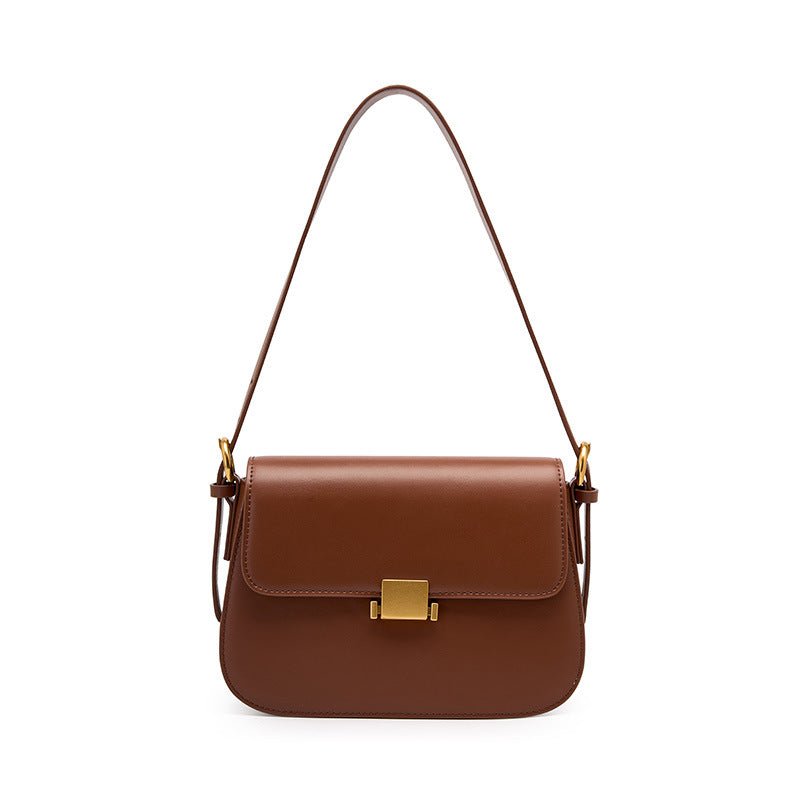
ELENA – Women's Small Leather Top-Handle Bag, Square Clasp, Crossbody
Regular price
90,00 €
+ Add to Cart



Cowhide, lambskin, calfskin, full grain, pebbled, nubuck, vegetable-tanned leather… When you start looking into leather bags, you quickly discover there is not one leather but dozens. And these differences are not just a matter of vocabulary: they determine the bag's look, feel, strength, care and the way it ages.
This comparison, part of our "Leather" series, reviews the different types of leather for handbags according to three criteria: the animal of origin, the layer of hide used and the finish. For the basics, start with our genuine leather bag guide.
Cowhide leather comes from adult cattle. It is the most widely used leather in leather goods: thick, dense and strong, it withstands rubbing well, keeps its shape and ages elegantly. Depending on its thickness and tanning, it suits structured bags as well as soft styles. It is the material of the vast majority of our bags, from MILAN SPRING to NOÉMIE.
Calfskin, from young animals, has a finer grain and a smoother surface. It is highly prized for high-end bags, but more delicate and more expensive. Lambskin is extremely soft and supple, almost velvety: wonderful to the touch, it scratches and marks easily, which makes it better suited to evening bags. Finally, goatskin has a naturally pronounced grain and good strength for its light weight.
For an everyday bag, cowhide remains the best compromise between robustness, structure and price. That is why we devote a whole article to it in this series.
A hide is divided into several layers. The grain is the top layer, the one that was in contact with the outside: its fibres are tight, which makes it strong and durable. A full-grain leather keeps this layer intact, with its pores and small natural marks: it is the highest-quality leather, the one that develops the most beautiful patina.
A corrected-grain leather has been lightly sanded to remove imperfections, then coated with a finish (pigment, embossed grain). It is more uniform and more stain-resistant, but breathes a little less and develops less patina. It is a perfectly respectable leather, very common in leather goods.
The split is the lower layer, obtained by splitting the hide. More fibrous and less strong, it is used for suede, or coated with a film to imitate the grain (this is called coated split). It is less durable: it is often what lies behind very cheap "leather" bags. We cover these terms in a dedicated article in the series.
Smooth leather has a soft, sometimes slightly shiny surface. It is elegant, easy to clean and perfect for dressy bags. The trade-off: scratches show more, though they fade with the patina. The smooth leather of MILAN SPRING or LIVIA, designed for evenings out, illustrates this look well.
Pebbled leather has a texture, natural or embossed. It is more tolerant of scratches and small knocks, which makes it an excellent choice for an everyday bag. Patent leather, coated with a very shiny layer, is spectacular but can crack and mark at the folds. Suede and nubuck, with their velvety feel, are superb but dislike water and stains: they need specific care.
Finally, some bags play on finishing details: visible stitching, pleats, contrast topstitching. MILLER with its fine visible stitching, or EMY with its delicate pleats, show how the same cowhide leather can take on very different faces.
Tanning is the process that turns a hide into rot-proof leather. Chrome tanning (mineral) is the most common: fast, it gives a supple leather with stable colours, more water-resistant and available in a wide range of shades. The vast majority of bags on the market use this process.
Vegetable tanning, using natural tannins from bark or fruit, is slower and more artisanal. It produces a firmer leather with a characteristic smell, which darkens noticeably and develops a strong patina over time. Much loved by enthusiasts, it is also more sensitive to water and stains.
Neither is "better" in absolute terms: chrome tanning favours ease of living and colour stability, vegetable tanning favours evolution and character. For a coloured bag carried every day, the former is often more practical.
Compared with leather, faux leather (PU or PVC) imitates the look without containing animal hide. It is light, inexpensive, easy to clean and comes in every colour. Its limit is its lifespan: it does not develop a patina and can crack or peel over time, especially at folds and handles. Our LYA, in faux leather, is designed for casual outings and embraces this choice of lightness.
So-called "plant-based" materials (made from apple, cactus, grape…) generally mix plant fibres with a synthetic binder. They are improving fast, but their durability varies greatly from one manufacturer to another.
To help you tell real leather from its imitations, we will publish a dedicated article with six simple tests. For now, remember that the product page should always clearly state the material: it is an obligation for serious sellers.
For a bag carried every day, a cowhide leather, ideally full grain or well-made corrected grain, smooth or pebbled, chrome-tanned, offers the best balance of robustness, easy care and elegance. Calfskin and lambskin suit more precious pieces, vegetable tanning suits lovers of a strong patina. Discover our cowhide leather bags in the all bags collection, and to pair the right material with the right shape, reread our guide to the types of handbags.
For everyday use, good-quality full-grain or corrected-grain cowhide leather is the most balanced: strong, easy to care for and durable.
Smooth leather is more elegant but shows scratches more; pebbled leather, with its texture, is more resistant to everyday marks.
It is very soft but fragile. It is better suited to an evening bag or one that is used lightly.
Leather tanned with natural tannins. Firmer, it darkens and develops a strong patina over time, but is more sensitive to water.
No, it is light and affordable. But it ages less well than leather and is better suited to a backup or trend bag.
Main article: genuine leather bags: what to know before you buy. All the articles in the series: leather and its care.